Consistency gets easier when your workouts are coached, structured, and built around real life.
Staying consistent with Fitness Classes sounds simple until your calendar fills up and your energy dips. We see it all the time in Maplewood: adults juggling work, family, commutes, and the kind of nonstop schedule that makes “I’ll go tomorrow” feel reasonable. The good news is that consistency is not a personality trait, it is a system you can build.
Our approach to Fitness Classes is designed to take the guesswork out of training. You show up, we coach, and you leave knowing you did the right work for your body that day. Over time, that structure turns effort into momentum, and momentum turns into results you can actually feel in daily life.
If you want strength, endurance, and confidence without living at the gym, the key is learning how to train smart, recover well, and keep showing up even when life is busy. Let’s break down how to do that in a way that fits Maplewood life.
Why Fitness Classes work when solo workouts stall
Most people do not quit because they do not care. People quit because the plan is unclear, the workouts feel random, or progress is hard to measure. Fitness Classes remove a lot of those friction points by creating a repeatable routine with coaching and community baked in.
When you train in a coached group setting, you get three things at once: a time on the calendar, a program that makes sense, and an environment that keeps you honest. That combination matters more than the “perfect” workout.
We also keep sessions focused on functional training, meaning you are building strength and capacity that shows up outside the studio. You are not just chasing a sweat. You are building the ability to move better, lift with confidence, and sustain effort.
What a 60-minute class should include to drive real progress
A well-designed class is not just hard. It is intentional. In our 60-minute sessions, we structure the hour so you are warmed up properly, coached through quality strength work, pushed safely in conditioning, and brought down with recovery.
Warm-up and joint mobility that actually prepares you
We start with movement prep that opens up the joints you use most: hips, ankles, shoulders, and thoracic spine. This is not “wasting time.” It is how you squat deeper, press more comfortably, and reduce the risk of those annoying tweaks that derail consistency.
You will usually see mobility flows, activation drills, and breathing cues that help you move with better mechanics. If you sit a lot during the day, this part alone tends to feel like a reset.
Functional strength using compound movements
Strength is the engine for everything else. We prioritize compound lifts and patterns that give you the most return on your time, like squats, deadlifts, hinges, pushes, pulls, carries, and core bracing.
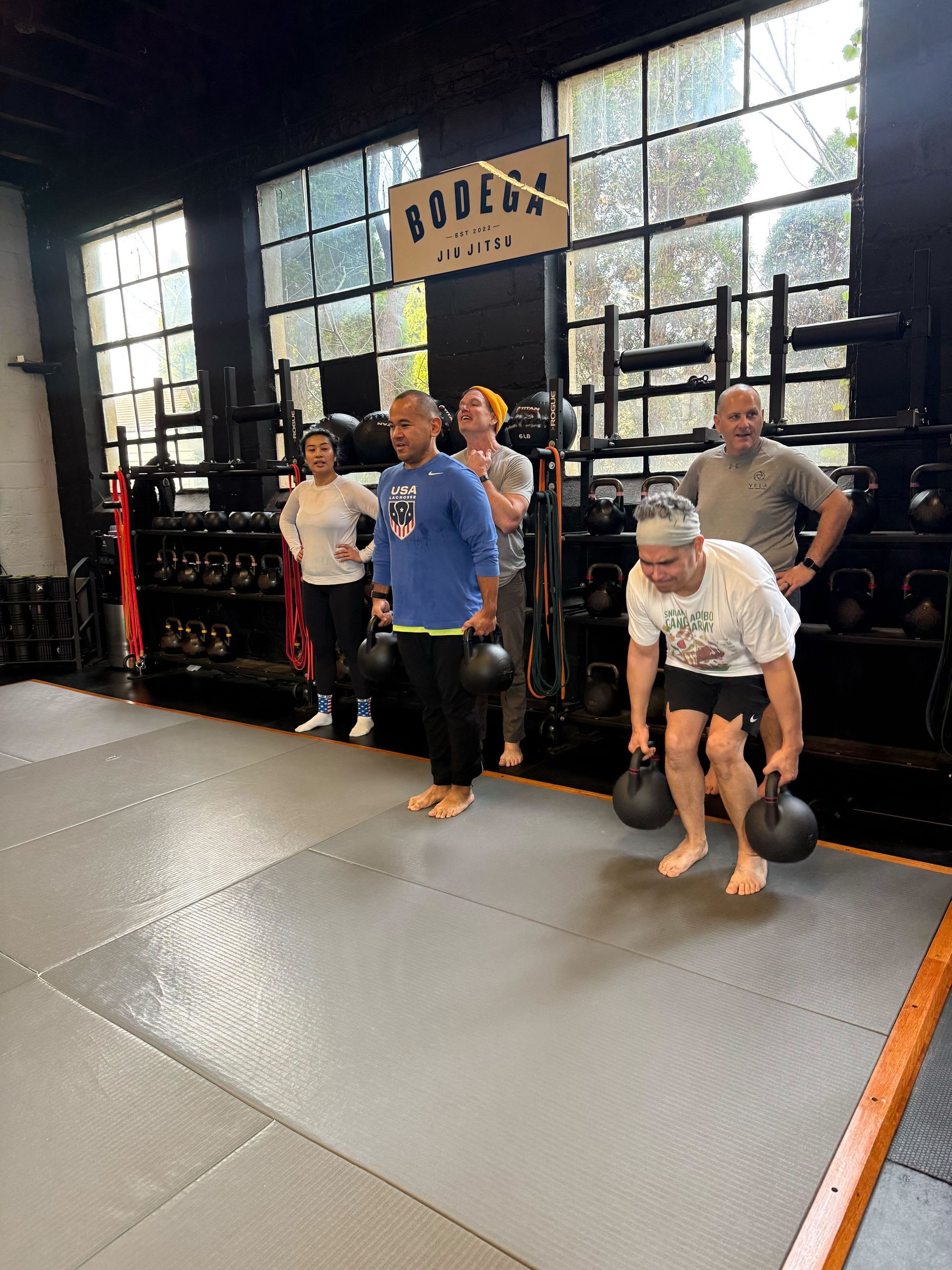
Because we coach in a small group setting, we can scale loads and variations so you can train at the right level. Some days that means building up to heavier sets. Other days it means dialing in tempo, range of motion, or stability. Either way, it is progress.
Conditioning that builds endurance and grit without breaking you
Conditioning is where many programs go off the rails by doing too much, too often. We use interval-style work to build stamina, power, and resilience, but we balance it with technique and recovery. Think high-energy cardio mixed with intentional pacing and good movement quality.
If you have ever finished a workout feeling wrecked for two days, you know that approach is not sustainable. Conditioning should challenge you, not punish you.
Cool-down and recovery so you can come back again
Consistency depends on recovery. We finish with downshifts: breathing, mobility, and simple recovery work that helps your nervous system settle. It is a small piece of the hour, but it matters more than most people expect, especially if stress is already high.
The consistency formula we coach in Maplewood
If you want Fitness Classes to actually change your body and your performance, you need a plan you can repeat. We teach consistency as a skill, not a hope.
Here are the habits that make the biggest difference for our members.
Pick a realistic weekly target and protect it
Many adults do best starting with three classes per week. It is frequent enough to build momentum and see progress, but not so much that life collapses the plan.
If you are already active, four classes per week can work well, especially if your schedule is stable. If you are new, two classes per week is still a strong start. The key is doing the number you can maintain.
Use the class schedule as your default decision
Decision fatigue is real. If you rely on motivation, you will miss more workouts than you want to admit. We encourage you to choose your weekly times in advance and treat them like appointments.
When you follow the class schedule consistently, you remove the daily debate about whether you should train. You already decided.
Train with intent, not ego
Consistency falls apart when every workout becomes a test. Your body needs hard days and easier days. We coach you to push when it is appropriate and scale when it is smart, so you keep stacking weeks.
That can mean lighter loads with cleaner reps, swapping an impact movement for a lower-impact version, or adjusting volume when sleep is rough. The goal is to keep training, not to “win” Tuesday.
How to see results from Fitness Classes without overcomplicating it
Results come from a few fundamentals done repeatedly. We keep the focus on what works, and we make it measurable so you know you are moving forward.
Expect a timeline that matches physiology
Most adults notice early wins in 2 to 3 weeks: better energy, improved mood, less stiffness, and a little more confidence in movement. Visible body changes often show up in 6 to 10 weeks, depending on sleep, nutrition, and stress.
Strength and conditioning improvements can start sooner, especially if you are tracking benchmarks. That is why we like simple performance measures, not just the scale.
Use progressive overload, even in a group setting
Progressive overload means you gradually increase challenge over time. In Fitness Classes, that can look like adding load to a deadlift, increasing reps with the same weight, improving your range of motion, or reducing rest while keeping form.
Because our coaching is hands-on, you are not stuck doing the same weights forever. You get guidance on when to push and when to refine.
Build explosiveness and endurance for “everyday athlete” life
Explosive training is not just for athletes. Adults benefit from power work because it supports quicker reactions, stronger joints, and better overall athleticism. We layer in explosive elements in a controlled way, paired with strength and mobility, so your training stays balanced.
Endurance work is similar: it is not about suffering. It is about building the ability to sustain effort, recover, and handle real-world demands.
What makes small group coaching a shortcut to sticking with it
Large gyms can be overwhelming. When the room is crowded and you are guessing what to do, it is easy to disappear. In small groups, you are seen. That changes everything.
We cap our classes so you can get real coaching, real adjustments, and real accountability. Not in a harsh way, more like: someone notices if you are moving differently today, or if your form needs a tweak, or if you are ready to add weight.
Small groups also create a certain momentum. When the room is working, you work. On days you feel a little tired, the environment carries you just enough to get through the first five minutes, and then you are in it.
A simple weekly plan you can actually follow
If you want an easy structure, this is a strong starting point. It works well for adults who want strength, conditioning, and mobility without overtraining.
1. Commit to three Fitness Classes per week for the first month, on the same days if possible
2. Treat the warm-up as part of training, not filler, and move with focus
3. Lift with clean mechanics first, then add intensity gradually week to week
4. Push hard in intervals when the movement quality is there, and scale when it is not
5. Walk daily and sleep consistently so your workouts can “stick” and your body can adapt
If you want more, we can help you progress from there. But starting simple is often what makes it sustainable.
Common questions we hear before your first class
Are classes beginner-friendly?
Yes. We coach every session so you can start where you are and build from there. Beginners get clear options and form coaching, and experienced members get progressions that keep training challenging.
What do I need to bring?
Comfortable training clothes, water, and a willingness to learn. We handle the structure, equipment, and coaching. If you are unsure about anything, arriving a few minutes early helps.
Will I get enough individual attention in a group?
That is the point of keeping groups small. We coach movement mechanics, provide cues, and adjust exercises so your training fits your body, not a one-size plan.
How soon should I increase frequency?
If your recovery is good, your sleep is steady, and you are not constantly sore, adding a fourth day can be a great step. If you feel beat up, stay at two to three days and focus on quality.
Take the Next Step
Consistency is not about going all-out once in a while. It is about showing up to a plan that is smart, coached, and repeatable, then letting time do its job. When you train with intention, build strength through compound movements, and balance intensity with mobility and recovery, results stop feeling random.
That is exactly how we run Fitness Classes at Soma MVMT in Maplewood. If you want a place where you can train hard, move well, and stay consistent without getting lost in the crowd, we would love to help you get started.
Ready to try a class and see how our coaching and structure feels in person? Visit https://somamvmt.com/ to take your next step.
Strengthen your body and mind through structured fitness classes at SOMA MVMT—join your free class today.